
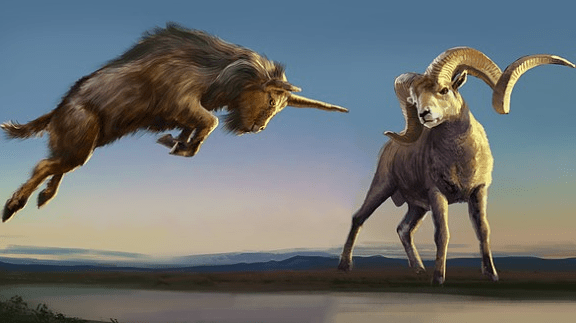
“I (Daniel) was considering the horns, and there was another horn, a little one, coming up among them, before whom three of the first horns were plucked out by the roots. And there, in this horn, were eyes like the eyes of a man, and a mouth speaking pompous words.” – Daniel 7:8
Continuing in our series on Daniel’s Division, we find ourselves at another division in the book of Daniel. In my last post, we observed the thematic pattern chapters 2 through 7 demonstrate. We saw a sequence of themes unfold and repeat. This pattern inherently linked chapters in Daniel to give us a grand theme that the kingdoms of man will naturally bend towards placing themselves above God. At it’s climax, they will then persecute God’s faithful ones. The persecution will be great, but God will redeem those who are enduring the persecution. And finally, God will punish those so prideful to compare themselves to God and persecute the righteous. This grand theme is carried and repeated through the first 7 chapters in Daniel. However, as we move into the latter half of Daniel chapter 7 and proceeding chapters, scripture narrows its focus to elements merely glazed over previously. When Daniel was given this vision of the four beasts, he had special interest in the fourth beast, particularly in the ten horns and the little horn speaking arrogantly. Today we are going to do as Daniel did; we are going to “consider the horns”.
In the later chapters of the book of Daniel, he is instructed to seal up the prophecy of this book and rest. It was not Daniel’s job to understand everything that God was telling him in his visions. His visions were well before his time and there were so many unknowns yet to be discovered to make more sense of his visions. He is then told that a time will come when “knowledge will increase” concerning these things. We are not any smarter than Daniel. In fact, Daniel was one of the smartest and wisest of his time. However, today we have a lot more information to work with than what Daniel did in his day. We have the New Testament filled with additional revelation consisting of parallels and references to Old Testament texts supplementing the story God is giving us knowledge of. This additional information helps us understand the bigger picture of Daniel’s prophetic visions, that our knowledge may increase.
Before we dive in, I want to begin with a general overview of these remaining chapters in Daniel. In short, it’s already been summarized for us. Daniel is “considering the horns”. These horns symbolize the final kingdom(s) of the world before the “stone” (Christ) comes hurling in to destroy the wicked and establish His rule on this earth. These last remaining chapters take a magnifying glass to zoon our attention to the specifics surrounding this kingdom and this “man”, the little horn. They consist of reiterations of this climactic time.
We first get an image of this man, the antichrist, in chapter 8. This is demonstrated through the use of typology. We know this because the little horn in Daniel’s previous vision was on the fourth beast. He succeeds the fourth beast and comes along after the 10 horns (kings). However, in chapter 8 we are given another reiteration of the 2nd and 3rd beasts. In other words, the Greek and Medo-Persian empires are symbolically being described again. This time they are symbolized as 2 animals. First upon the scene is a ram. Daniel 8:2-4 says,
“Then I lifted my eyes and saw, and there, standing beside the river, was a ram which had two horns, and the two horns were high; but one was higher than the other, and the higher one came up last. I saw the ram pushing westward, northward, and southward, so that no animal could withstand him; nor was there any that could deliver from his hand, but he did according to his will and became great.”
This ram had two horns, one being taller than the other. This reflects the previous vision of Medo-Persia in describing a bear rising up on one side to attack. This symbolically represents the power imbalance of this empire. Between the Medes and the Persians, it was the Persians who were the much stronger force in the alliance. They are the taller horn. They are the strong hand of the bear to which they rise and attack with. This ram demonstrates great power and might. It says that no one could withstand them.
However, a male goat was soon thrust into the scene in Daniel’s vision. This goat came from the west swiftly and had one prominent horn between his eyes. The goat attacked the ram ferociously and broke the ram’s 2 horns. It trampled the ram and no one could withstand him. The nice part about this vision is that it is interpreted directly to us. We know that the ram is Medo-Persia, and we know that the goat symbolizes Greece. The prominent horn on the goat is said to be the first king of this empire. Something interesting happens to this prominent horn afterwards that we must take note of.
Daniel 8:8-12 says,
“Therefore the male goat grew very great; but when he became strong, the large horn was broken, and in place of it four notable ones came up toward the four winds of heaven. And out of one of them came a little horn which grew exceedingly great toward the south, toward the east, and toward the Glorious Land. And it grew up to the host of heaven; and it cast down some of the host and some of the stars to the ground, and trampled them. He even exalted himself as high as the Prince of the host; and by him the daily sacrifices were taken away, and the place of His sanctuary was cast down. Because of transgression, an army was given over to the horn to oppose the daily sacrifices; and he cast truth down to the ground. He did all this and prospered.”
We have direct fulfilled prophecy to this in our known history. The king of Greece that this vision speaks of is Alexander the Great. “Therefore, the male goat grew very great”. But what happened to him at the height of his power? He died of typhoid fever. “The large horn was broken”. In place of this horn grew four notable smaller horns. After Alexander the Great died, his four rival generals took over. Ptolemy ruled over Egypt. Seleucus reigned over Mesopotamia and Iran, also including Israel. Cassander reigned over Greece, and Lysimachus over Asai minor. These four generals filled the void of rulership, however the empire never reached the height of power attained under Alexander the Great. Here is where things get interesting. “And out of one of them came a little horn which grew exceedingly great toward the south, toward the east, and toward the Glorious Land (Israel).” This use of language, referencing a little horn, reflects the little horn spoken of in chapter 7. In Daniel’s previous vision, however, this little horn would be of the 3rd beast, not the fourth. Therefore, this is without a doubt talking about a different “little horn”. There is much overlap that we will get into in a moment, but this prophecy has past fulfillment that we once again can clearly observe in world history.
The land of Israel was contested over between the dynasties of Seleucid and Ptolemy. The Seleucids eventually succeeded in taking control over the region in 198 BC. These efforts were led by their ruler at the time, Antiochus III. In 170 BC, his son, Antiochus Epiphanes IV became king, and not long after, decided that he wanted to impose his Hellenistic ways on his kingdom. This also included the worship of the Greek gods. He had no problem forcing these beliefs upon the surrounding pagan areas he conquered, but this wasn’t going to fly in Judea. Judea gave much resistance to this; so much that Antiochus IV sieged Jerusalem. He plundered the temple and took away all the sacred vessels. He was considered a madman by the Jews. He gave himself the name “Epiphanes” because it meant “God manifest.” On record, he considered himself to be the incarnation of Zeus. After a humiliating defeat in battle against Egypt, he returned to Jerusalem just to vent his anger upon them. He ordered his soldiers to brutally slaughter anyone and everyone they could find. It didn’t matter if they were men, women, elderly, children or babies. All were to be killed. It is recorded that 80,000 people were killed within three days.
If that wasn’t bad enough, Antiochus IV Epiphanes burned all the sacred scriptures he could find, he erected a statue of Zeus in the temple and sacrificed pigs upon the altar.
Antiochus IV Epiphanes fits the description of the little horn in Daniel 8 so well that critics insisted that the book of Daniel had to be written after this event. However, the actual dating of its writing is insurmountably clear. There is no evidence to suggest it was written after this event.
“He even exalted himself as high as the prince of the host”. Antiochus considered himself Zeus incarnate. “The daily sacrifices were taken away”. He outlawed all Jewish religious practices. “The place of God’s sanctuary was cast down.” He ransacked and desecrated the temple. “He cast truth down to the ground”. The pages of the holy scriptures were cast down and burned to be replaced by Hellenism. “He cast down some of the stars and trampled them”. In other words, he greatly persecuted God’s people. “He did all this and prospered.” He was successful.
Consider the horns we have talked about. We have a little horn mentioned on the fourth beast of Daniel chapter 7, and now we have a little horn arising from what we know to be the 3rd beast talked about now appearing in chapter 8. Both of them are said to speak blasphemous words against God and exalt themselves higher than God. It is said that they will persecute the people of God, take away the daily sacrifices and change their law.
What is so significant about these little horns?
They are significant for the purpose of typology. Typology is such a powerful tool that God uses to describe future events in more detail. Typology is God’s, “For example…”. When we try to describe something to someone and it’s not crystal clear, we resort to examples. We say, “For example, ______”. We fill in the blank with a related description of the thing we are talking about. Well, God is God. God doesn’t have to go and find a related example to relate to what he is saying. He can literally make an example and place it in his desired time. That’s what God is doing with this second “little horn”. The whole point of inserting it here is to give you a better understanding of the main little horn of chapter 7. In chapter 7, we are talking about the end of time. We are talking about the climactic ending where Christ, the rock, will come hurling in and destroy the wicked beast-like kingdoms of man and establish his kingdom. God merely backtracks slightly and says, “I’m going to give you an example of what this beast of a man is going to look like, (The little horn). God, being completely sovereign, completely outside of time, then has the power to insert this example in our timeline. And no, that doesn’t mean Antiochus IV Epiphanes was held against his will to fulfill this typological prophecy. This was completely according to his will as well. All God had to do was release him to do exactly what he wanted to do, and in doing so, it completely fulfilled God’s will for this little horn “type” to manifest itself as it did through Antiochus. Antiochus IV Epiphanes was a type of the little horn described in chapter 7 that will take place at a future time.
That is the theological purpose for its placement here in Daniel 8. The focus is still on God’s climactic ending of the world, but he uses this typological example to help us understand the blueprint of what’s to be expected. This resonates with what Jesus said in the book of John. John 16:1-4 says,
“These things I have spoken to you, that you should not be offended. They will put you out of the synagogues; yes, the time is coming that whoever kills you will think that he offers God service. And these things they will do to you because they have not known the Father nor Me. But these things I have told you, that when the time comes, you may remember that I told you of them.”
The reason God gave Daniel this vision is for the same reason Jesus told his disciples of these things, as spoken in John. It’s to prepare us, so that we will not be offended when these atrocities happen to us. Because here’s the thing about typology, or “types” that we see in scripture, there is always a fulfillment of the type that is to be the “main” one. For example, all throughout scripture we see plenty of Jesus “types”, or savior “type” characters. All of them have failed morally in some regard, except Christ. Christ was the fulfillment. Christ was the truest type. In the same way, though we have examples of antichrist “types” in scripture and seen throughout history, only one will fully live up to its name. And we know that we haven’t come across him yet because the Bible directly links this one to the end of days. In other words, the “rock” has not come to utterly destroy the kingdoms of man and establish His rule in their place yet. So we know that we haven’t “missed” it. There will be no missing it. We have only ever experienced shadows of the antichrist.
Nonetheless, we have the blueprint: A man rising to power and placing himself above God, desecrating the temple, taking away the religious traditions and demanding worship, and persecuting believers. Only pre-wrath eschatology follows that blueprint. Consider all I have written on that in other end times posts. There’s no missing this when it happens because we will be on the receiving end of that great persecution/tribulation so mistakenly blurred away as God’s wrath. Was the immense persecution Antiochus IV Epiphanes enforced against the Jews God’s wrath? No. Judea was standing firm in their belief of God and refusing to bow down to Zeus and the other Greek gods brought in. They resisted and stood firm. As will it be when the real antichrist comes. There will be great tribulation like the world has never seen, but “for the elect’s sake those days will be shortened” and the rock will come to redeem those who are faithful to Him. That is the grand theme that can’t be missed in Daniel. That is the eschatological blueprint God has laid out for us in Daniel. When we comparatively consider these horns, this truth is obvious.
I pray that you found this post to be insightful, and gave you a better appreciation for God and His Word as he prepares us for the tribulations of this world we, as believers, will face. Praise the Lord! God bless!
 Softly Spoken Truth