
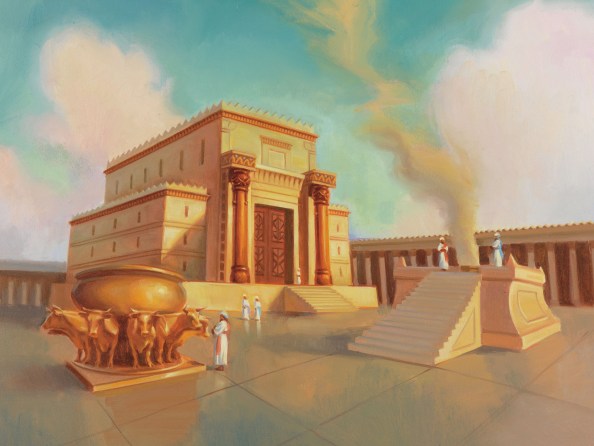
We come now to a less controversial topic, however, it is a topic that some theological camps poke at and stir the pot with. It has been stirred enough recently for me to begin spending some extra time breaking it down for clarity. As I have mentioned in other posts, sometimes my questions derive from real-time conversations with people in Facebook groups who have much different Eschatological views than I do. In the past few months, I decided to jump into a group that was said to be of those who left dispensationalism and now subscribe to a different theological framework. I lean more towards a Progressive Covenantalism theological understanding, so I thought that this could be a good platform for dialogue. Apparently, I have not learned my lesson with Facebook groups because my experience is rarely edifying. This experience, once again, proved that statement true. Historical interpretations such as Preterism reigned supreme in this group, so naturally, as a futurist, I stuck out like a sore thumb. Amongst all the condescension and intellectual dishonesty in what could hardly be called “debate”, there did come a meaningful question regarding the nature of the temple observed in end times texts. That question is:
What need is there for a new temple in Israel if the Bible makes it clear that we are the new temple?
A futurist believes that a temple will be built in Jerusalem before Daniel’s 70th week begins. This is one of the smaller reasons why I have given pushback to pre-trib interpretations and the concept of “imminency”. Christ’s return cannot be imminent if this end times temple hasn’t been built yet. However, whether you hold to a Pre-Tribulational view or a Pre-Wrath view as I do, the fact of the matter is that we believe a temple will exist during the times of the end. A futurist takes a literal approach to the text to come to this conclusion. The only way to avoid this simple understanding is to apply an allegorical hermeneutic to the text, and therefore, make the claim that this temple is spiritual.
The issue a futurist faces here is that scripture indicates that as image bearers, filled with the Holy Spirit, we are the temple of God, (1 Corinthians 3:16-17, 6:19, 2 Corinthians 6:16). The challenge being raised here is that God has no need for a new temple – which was the temporary means by which God could dwell with His people – because Christ has fulfilled this in sending the Holy Spirit to permanently dwell within the hearts of true believers. Therefore, the claim is that this is meant to be understood as a spiritual temple. There will be no new physical temple in Jerusalem. Building another physical temple would, in and of itself, be an abomination to the Lord.
The abomination of desolation is a good place to start when talking about whether this is a spiritual or physical temple. In Daniel, the Olivet Discourse, and in Revelation we are told that there will be an abomination of desolation set up in the temple. It is historically understood that the antichrist will set up a sacrilegious object within the temple and declare himself as God. We were given a typological example of this abomination of desolation shortly after 170 BC. At this time, Antiochus Epiphanes IV became king of the Seleucid dynasty, which was the current authority reigning over Israel. Antiochus Epiphanes IV desired to enforce the worship of the Greek deities in all the lands under his control. This did not fly well in Jerusalem. Judea gave much resistance to this; so much that Antiochus IV sieged Jerusalem. He plundered the temple and took away all the sacred vessels. He gave himself the name “Epiphanes” because it meant “God manifest.” He considered himself to be the incarnation of Zeus, and thus, he erected a statue of Zues in the temple, sacrificed pigs to it, and demanded worship as God.
This was a historical, typological abomination of desolation. It was very physical and very atrocious. This is the model we are given for the second description of an abomination of desolation set in the future. Some “experts” try to spiritualize this event and describe it in more of a psychological unrest/testing that will take place within the hearts of believers. It is likened to the apostasy that is said will come. It is claimed that this abomination of desolation takes place within the temple/believers in Christ, and many will fall away, (apostatize).
This is problematic in many aspects. First, and most notably, do believers in Christ not have a strong man dwelling inside them that Satan must bind in order to spoil it and desecrate it? This allegorical mess leads us down a trail to which we must deny the doctrine of eternal security. It is believers in Christ who serve as temples for the Holy Spirit. Therefore, if the abomination of desolation leads to the apostasy, it implies that believers can lose their salvation. It implies that Satan has the ability to bind the Holy Spirit and plunder His temple while He is home. This doesn’t work.
Secondly, some Preterists see this as problematic as well and decide to cherry pick this event and claim that this part of the prophecy was literal. They claim that it happened in 70AD when Jerusalem was sieged by Rome. The problem here, which I have gone over extensively in my post called, “The Early Antichrist”, is that no singular person fulfills the text or matches the typological model seen in Daniel. Preterist’s can’t seem to all agree who their early antichrist is. “It’s Titus! It’s Vespasian! It’s Nero! It’s all of them!” Quite frankly, it’s neither of these. Nero died before 70 AD and never even set foot in the temple. Vespasian didn’t either, and he never erected a statue and declared himself as God. It was only after he died that deification was attributed to his name, (As was just about every other Roman emperor). Titus was the only one who actually sieged Jerusalem, but he fails every other qualification as well. In fact, Titus directly ordered for the Temple to NOT be destroyed. However, Arab soldiers serving in his army went against his orders and destroyed it anyways. Even then, he ordered for the fires to be put out. This man caused no abomination of desolation. None of these men even remotely lived up to the atrocities Antiochus Epiphanes IV committed in the temple. So, it’s bad enough that we are cherry picking passages that don’t fit our theological system. But even when Preterists do this, it does not work.
How do we answer this question if the temple is to be taken literally as a physical temple that will be built in the future? To respond to this criticism, I believe we must first visit what Paul says of Israel in Romans 11:25-26a. It says,
“I do not want you to be ignorant of this mystery, brothers and sisters, so that you may not be conceited: Israel has experienced a hardening in part until the full number of the Gentiles has come in, and in this way all Israel will be saved.”
In Romans, Paul spent an incredible amount of time demonstrating Israel’s place as a people in this New Covenant age. In chapter 9 of Romans, he drives the point home that “not all who are descended from Israel are Israel.” This highlights the conditional nature of the old covenant made with Israel. Not all who are of Israel upheld this condition. This condition, Paul continues on to demonstrate, is faith. Romans 9:30-33 says,
What then shall we say? That the Gentiles, who did not pursue righteousness, have obtained it, a righteousness that is by faith; but the people of Israel, who pursued the law as the way of righteousness, have not attained their goal. Why not? Because they pursued it not by faith but as if it were by works. They stumbled over the stumbling stone. As it is written: “See, I lay in Zion a stone that causes people to stumble and a rock that makes them fall, and the one who believes in him will never be put to shame.”
What we are seeing here is that Israel sought righteousness through their own means. Generally speaking, Israel missed their goal because they focused on working for their salvation as opposed to allowing the law to be their schoolmaster pointing to Christ. Jesus, as the text explicitly states, was their stumbling block. In their devotion to works, they missed Christ. Paul acknowledges this in Romans 10:1-3, which says,
“Brethren, my heart’s desire and prayer to God for Israel is that they may be saved. For I bear them witness that they have a zeal for God, but not according to knowledge. For they being ignorant of God’s righteousness, and seeking to establish their own righteousness, have not submitted to the righteousness of God.”
This is speaking not of true spiritual Israel who has faith, but as national Israel, who generally lacks it. Israel has such great zeal for God, but they missed God’s righteousness in Christ. Other translations say that “their zeal is misplaced.” They missed the simple truth of the gospel, which Paul states for us, that ‘Anyone who trusts in him will never be disgraced.’ Jew and Gentile are the same in this respect. They have the same Lord, who gives generously to all who call on him. For ‘Everyone who calls on the name of the Lord will be saved.”
Therefore, since Israel missed this, which was the whole purpose of the law being given in the first place, God will “rouse their jealousy through people who are not even a nation.” He “will provoke their anger through the foolish Gentiles.” Israel rebelled against the Lord and was disobedient to Him, though His arms were always opened to them. This is a nation that was given everything. God revealed Himself to them. They were given God’s favor, given His covenants, given His law, given His wonderful promises, and given the Son of God for the forgiveness of sin. Paul builds all this up to demonstrate how hard they fell. But even by their failing, God used that too for His glory to open the door for believing gentiles to be grafted in. Doing this was not a means to an end. This wasn’t a means to reject Israel in entirety. It is stated in chapter 11 that God has spared the whole for the sake of a few. When Elijah the prophet complained to God about the people of Israel and wished for Him to avenge him, God replied by saying that there is yet 7000 others who have not bowed down to Baal. God is patient with hardened Israel on behalf of the remnant of faithful Israel. Paul furthers this point and says,
“It is the same today, for a few of the people of Israel have remained faithful because of God’s grace.” – (Romans 11:5)
So, we must have a healthy understanding that Israel’s temporary good standing with God is only based on the faith on a few who remain faithful. There is a remnant who God foreknows, but Israel in general remains hardened towards Christ. This is where the build-up leads to Paul’s statement in Romans 11:25-26a. This hardening has a timer. However, we cannot expect Israel to act any differently than they have consistently behaved in the past until that timer runs out. Paul says here that “Israel has experienced a hardening in part until the full number of the Gentiles has come in, and in this way all Israel will be saved.”
In other words, this hardening will end when the time of the Gentiles comes to a close and all have come in. In a Pre-Wrath interpretation, the full number of Gentiles comes in when the rapture of believers takes place. We are reminded of this prophecy in Revelation 6:9-11, which describes the great persecution/tribulation of believers in Christ just before the rapture takes place. It says,
“When the Lamb broke the fifth seal, I saw under the altar the souls of all who had been martyred for the word of God and for being faithful in their testimony. They shouted to the Lord and said, “O Sovereign Lord, holy and true, how long before you judge the people who belong to this world and avenge our blood for what they have done to us?” Then a white robe was given to each of them. And they were told to rest a little longer until the full number of their brothers and sisters – their fellow servants of Jesus who were to be martyred – had joined them.”
Paul and John are on the same page when it comes to there being a full number of believers needing to come in. During this time of intense persecution of believers, the Gospel will be spread to the nations. God is patient even in this time of great tribulation for the full number of gentiles to come in. However, at this time, Israel is still hardened. This leads me to believe that Israel will not build this new temple in response to God’s command. Israel is still hard-headed. Israel still has misplaced zeal. Israel is still trying to do things their own way. Because of this, I think it is likely that hardened Israel will welcome in a trojan horse, aka the antichrist, at the midpoint of Daniel’s 70th week. The antichrist will fulfill all the militarist aspects they expected in the coming messiah. He will demonstrate incredible power. He will perform miracles and deceive many. He has brought “peace” to the world through conquest during the first three and a half years of Daniel’s 70th week. He will make peace in the middle east through a covenant/treaty with many. He will seemingly fulfill all they wanted in a messiah. When persecution starts at the midpoint of Daniel’s 70th week, many Israelites will cheer him on. “How dare you reject our messiah? If you don’t worship him, you deserve punishment.” I am sure that many Israelites will be killed at this time. We must remember that this is only a “partial hardening”. Even now there is a remnant of believing Jews. But when this time comes, they will not be killed because they are Israelites. They will be killed because they reject this false messiah and believe in Christ. Believing Jews and gentiles alike will be severely persecuted at this time. And then,
“Immediately after the tribulation of those days the sun will be darkened, and the moon will not give its light; the stars will fall from heaven, and the powers of the heavens will be shaken. Then the sign of the Son of Man will appear in heaven, and then all the tribes of the earth will mourn, and they will see the Son of Man coming on the clouds of heaven with power and great glory. And He will send His angels with a great sound of a trumpet, and they will gather together His elect from the four winds, from one end of heaven to the other.” (Mat. 24:29-31)
Believing Jews and gentiles alike who are alive and remain will be gathered together to be with the Lord forever more. The rapture of believers brings in the full number of gentiles. The parallel in Revelation 6:12-14 says,
“I watched as the Lamb broke the sixth seal, and there was a great earthquake. The sun became as dark as black cloth, and the moon became as red as blood. Then the stars of the sky fell to the earth like green figs falling from a tree shaken by a strong wind. The sky was rolled up like a scroll, and all of the mountains and islands were moved from their places.”
In Revelation 7:9, immediately following this event, it states,
“After this I saw a vast crowd, too great to count, from every nation and tribe and people and language, standing in front of the throne and before the Lamb. They were clothed in white robes and held palm branches in their hands.”
We find out in the following verses that these are those who come out of great tribulation and “have washed their robes in the blood of the Lamb and made them white.” We also see described in this passage that upon experiencing this event, 144,000 Jews are then sealed. I believe that this indicates the end of Israel’s hardening. The rapture of believers is sure to stir that same jealousy Paul was prayerfully hoping for in Romans. It is here where we see hardened hearts becoming soft and receptive of Christ as Messiah. I don’t know if this is an immediate change of heart, or a gradual change, being sealed by God’s foreknowledge that they will turn to Him. But either way, the text indicates that this remnant will be protected by God for “a time, times, and half a time.” (Rev. 12:14-17) They will likely be ministered to by the two witnesses who begin their ministry during the last half of Daniel’s 70th week. For the remainder of Daniel’s 70th week, this remnant of believing Jews will be preserved, nonetheless. Whether you believe 144,000 is a spiritual number or a literal number, the fact of the matter is that it wasn’t until the rapture of believers shortly after the midpoint of Daniel’s 70th week that they became sealed by God.
I know it took me a long time to build up to the point, but the point I am making here is that I don’t believe Israel will be “correct” for building this temple. I believe that this is descriptive text, not prescriptive text. I don’t think there is a need for this future temple to be built at all. If Israel got Jesus right, then they wouldn’t have crucified Him. Paul drilled the point home that there is still a heart problem in Israel. They are not right with the Lord on account of their works. Generally speaking, they are lost and will continue to be lost until the fullness of the gentiles come in.
In the Old Testament, when Abraham was promised a seed and promised that it would be through his wife, Sarah, Abraham waivered in his faith. Instead of trusting in the Lord, he sought to take things into his own hands and decided to have a child with his servant, Hagar. Together, they had Ishmael. However, the promise was not to be fulfilled through Ishmael. This was a desperate attempt to fulfill God’s promises where faith lacked. It was misplaced zeal. As time continued, Sarah had a son, Isaac. Through Isaac the promise would be fulfilled. So too I believe it is with Israel today. Israel missed Jesus, and in doing so they have grown impatient and will continue to try taking matters into their own hands, trusting in their own righteousness.
The temple will be the result of misplaced zeal. We are the temple of God. Believers in Christ are the temple to which the Holy Spirit permanently resides in, both Jew and Gentile alike. However, like Paul, this healthy understanding of Israel’s hardness must also be met with solemn love and compassion. We too must be filled with desire for all Israel to be saved through the knowledge of Jesus Christ our Lord and Savior. We are fortunate that Israel rejected Christ, because it led to salvation being extended out to gentiles. God has a reputation of turning bad things into good things. I don’t find it hard to believe that He may also use Israel’s hardness as a catalyst to bring in everlasting righteousness and seal up all vision and prophecy.
Thank you for taking the time to read. I pray that you took something away from this that will serve well in your understanding of God’s plan for His people in the times to come. God bless!
 Softly Spoken Truth